
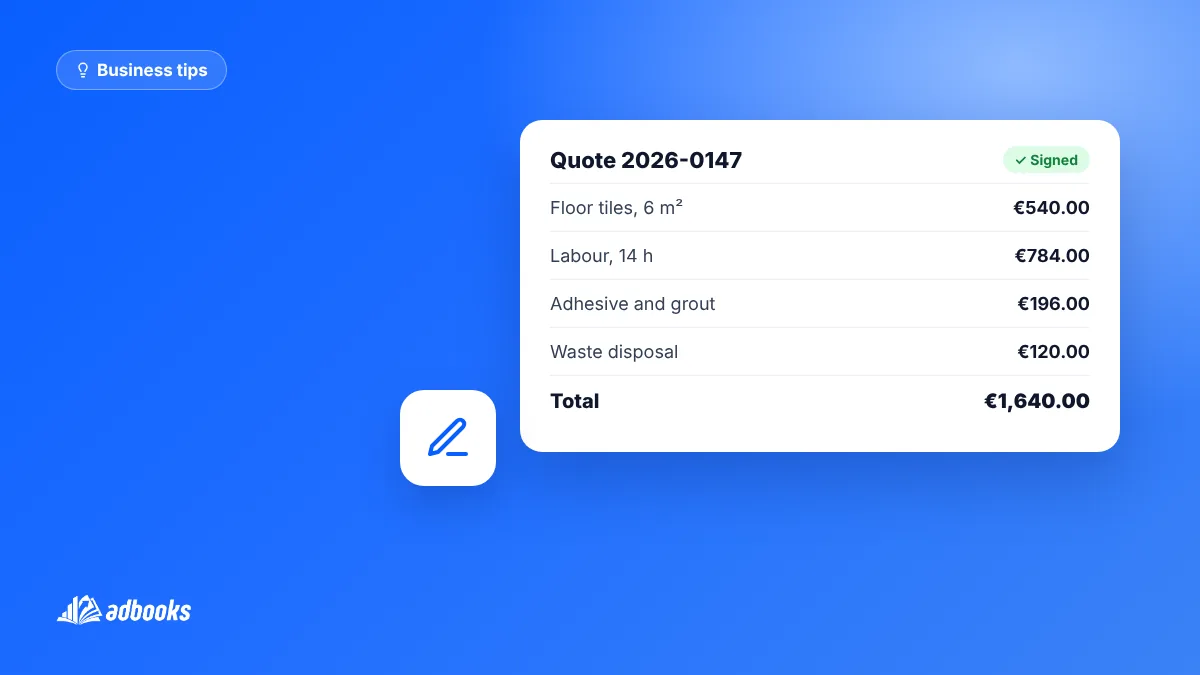
A quote is often the first real document a client sees from you - and for many jobs it decides who gets the work. A clear, complete quote wins more jobs, prevents arguments later and turns into an invoice without retyping. Here is how to write a quote for trade work that clients understand and accept.
In short
- A good quote lists every item with quantity, unit and price, so the client sees exactly what they pay for.
- Separate materials and labour, state what is not included and set a validity date.
- Send the quote the same day, as a link the client can open and sign on the phone.
- Once accepted, turn the quote into an invoice with one click instead of typing it again.
What a professional quote must include
Your details and the client's details
Company name, address, VAT number (if you have one), phone and e-mail - and the same for the client. For a private client, the name and the address of the job site are enough. Missing details are the most common reason a quote has to be sent twice.
Quote number and date
Number your quotes consistently (for example 2026-0147) so you can find them later and link them to the invoice. Add the date of issue and how long the quote is valid - 15 or 30 days is common in construction, because material prices change.
A clear description of the work
Write what you will do in words the client understands: "Remove old tiles and lay new floor tiles in the bathroom, approx. 6 m²" is better than "tiling work". The more precise the description, the fewer disputes about what was agreed.
Items with quantity, unit and price
Break the job into items: materials, labour, transport, waste disposal. Each item needs a quantity, a unit (m², m, pcs, h) and a unit price. Clients trust a quote they can follow line by line much more than a single total.
Taxes, discounts and the total
Show the net amount, VAT and the total separately. If you give a discount, show it as its own line so the client sees the value.
Payment terms and advance payment
State when and how you will be paid: for example 30% advance before the start, the rest after completion. For larger jobs, an advance invoice protects you from paying for materials out of your own pocket.
What is not included
List what the price does not cover - for example plastering after electrical work, or removing furniture. This one paragraph prevents most "I thought that was included" conversations.
How to price the job correctly
Start from your real costs, not from what a competitor charges. Calculate materials with a buffer for cutting and waste (often 5-10%), and price labour by your real hourly rate. If you are not sure what your hourly rate should be, read our guide on how to calculate your hourly rate.
For recurring work, keep a list of standard items with prices. You will write the next quote in minutes, and prices stay consistent from job to job. In AdBooks, the Estimator gives you a ready-made catalogue of items by trade - for example cables, sockets and EV chargers for electricians.
Send it fast - and make it easy to say yes
Speed wins jobs. A client who asks three companies for a quote often chooses the first professional one that arrives. Send the quote the same day if you can.
Instead of a PDF attachment that gets lost in an inbox, send a secure link via WhatsApp, Viber or e-mail. The client opens it on the phone, without an account or app, and can sign it right there. You get a notification as soon as it is signed - and you know exactly when to order materials.
Try it yourself: create your first quote in AdBooks free for 14 days - no credit card needed.
From quote to invoice without retyping
When the job is done, the invoice should contain exactly what was agreed. Turning the accepted quote into an invoice with one click saves time and removes typing errors. If you took an advance, the advance invoice is linked and deducted from the final invoice automatically.
Common mistakes in quotes
- One total without items - the client cannot compare and starts negotiating.
- No validity date - you are bound to old prices when materials get more expensive.
- Unclear scope - extra work turns into an argument instead of an extra invoice.
- Late sending - a competitor was faster.
- No follow-up - a short message after three days often wins the job.
Frequently asked questions
How long should a quote be valid?
For trade and construction work, 15 to 30 days is usual. Longer validity is risky when material prices change quickly.
Is a signed quote binding?
A quote signed by the client is a clear record of what was agreed, which helps a lot in case of disputes. The exact legal effect depends on your country, so for large jobs ask your accountant or lawyer.
Should I charge for writing a quote?
For small jobs, usually not. For large projects that need planning or measuring on site, many companies charge a fee and deduct it from the price if the client accepts.
Can I write quotes on my phone?
Yes. With software that runs in the browser, you can write and send a quote directly from the job site.
Conclusion
A good quote is clear, complete and fast. List every item, state what is not included, add payment terms and send it the same day as a link the client can sign. Do this every time and you will win more jobs with fewer arguments - and spend your evenings with family instead of with paperwork.