
Many tradespeople price labour from an employee’s take-home pay and then wonder why there is no profit at the end of the year. The real cost is much higher, and the hours you can bill are far fewer. Here is how to work it out.
In short
- Start from gross pay and the contributions you pay as the employer.
- Add meals, travel, equipment, tools and insurance.
- Divide by billable hours, usually 120 to 140 a month, not 170.
- Add your profit on top of the hourly cost, and only then you have the employee’s hourly rate.
Step 1: The monthly cost of an employee
Add up everything the employee costs the business in a month:
- Gross pay.
- Employer contributions, under your country’s rules. Your accountant knows the exact percentage.
- Meal, travel and site allowances.
- Workwear, tools, equipment and insurance, converted to a monthly figure.
Step 2: How many hours you can really bill
Of roughly 170 working hours a month, not all can be billed. Holidays, public holidays, sick leave, rain, driving, waiting for materials and tidying up all take a share. In practice 120 to 140 hours get billed.
Step 3: Cost per billable hour
Divide the monthly cost by billable hours.
Example: gross pay 1,400 €, employer contributions 15 %, allowances 220 €, equipment and insurance 80 €, 130 billable hours.
- Monthly cost: 1,400 × 1.15 + 220 + 80 = 1,910 €
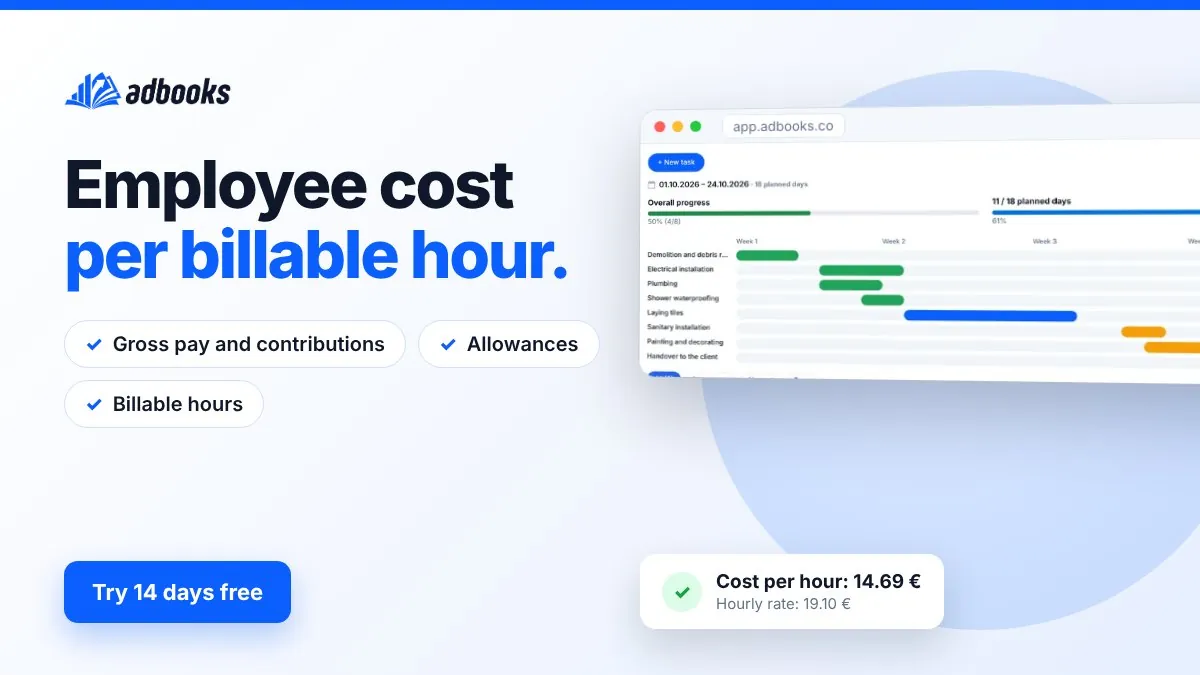
- Cost per billable hour: 1,910 ÷ 130 = 14.69 €
Step 4: The employee’s hourly rate
The hourly cost is the floor, not the price. Add the business’s profit, say 30 %, and you get the recommended hourly rate for that employee: 14.69 × 1.30 = 19.10 €. If you quote below the hourly cost, every hour that employee works costs you money.
Track hours per job
Only when you know how many hours went into which job do you know whether the price was right. In AdBooks the team logs hours per project, on the phone too, so next to invoices and expenses you see the real profit per site.
Frequently asked questions
Why not count 170 hours a month?
Because not all of them can be billed. Holidays, sick leave, weather and driving take a share, so in practice 120 to 140 hours get billed.
How much are employer contributions?
It depends on the country and type of contract. Your accountant knows the exact percentage for your business.
What is a good margin on an employee’s labour?
Usually 20 to 40 % above the hourly cost, depending on the work, the risk and the competition.