
On a bigger job you don’t wait until the end to see money. With interim invoices you bill the work done so far, stage by stage, and the client sees exactly what they are paying for. Here is how to set it up, from the quote to the final invoice.
In short
- Agree the payment plan in the quote: deposit, number of stages and the amount retained until handover.
- Each interim invoice states the stage or period, the quantities done and the deposit deduction.
- The final invoice covers the rest and the retained amount.
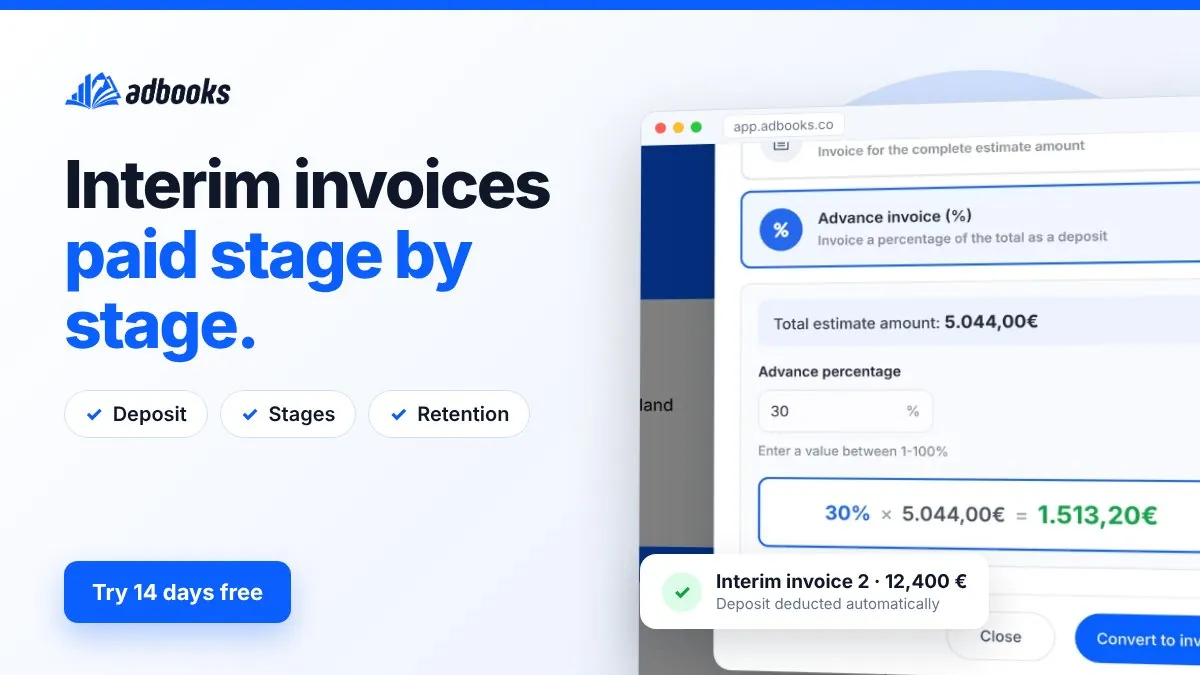
- In AdBooks the deposit is deducted automatically, and you see what has been billed and what is left.
Why bill in stages
On refurbishments, façades, roofs and new builds, materials and labour cost you a lot long before the job is finished. If you wait until the end, you are financing the client. An interim invoice bills the part of the job done up to a date or stage, before the final account.
The upside for the client: they pay only for work actually done, and they see it in black and white, line by line from the quote.
Step 1: Put the payment plan in the quote
Agree the payment plan before work starts and write it into the quote. A typical plan looks like this:
- Deposit on signing, for materials and the start of work, usually 20 to 40 %.
- Interim invoices for clearly defined stages, for example shell work, services, finishes.
- Retention until handover, usually 5 to 10 %, paid after the handover record is signed.
The deposit and payment plan calculator works out all the amounts for you.
Step 2: What goes on an interim invoice
- The number of the interim invoice and the contract or quote number.
- The stage or period it covers.
- Quantities done per quote line, with units.
- The pro-rata deposit deduction, if agreed.
- Net amount, VAT, amount due and payment terms.
On bigger jobs the supervisor or client also signs the interim invoice to confirm the quantities.
A worked example
A job worth 40,000 € excluding VAT, 30 % deposit, two interim invoices, 10 % retained until handover.
- Deposit on signing: 12,000 €
- Left for the stages: 40,000 − 12,000 − 4,000 = 24,000 €
- Each of the two interim invoices: 12,000 €
- Final invoice (retention): 4,000 €
40,000 € in total, and the money comes in as the work progresses. If the deposit is deducted pro rata, each interim invoice shows the full stage amount and a deduction for part of the deposit.
How it works in AdBooks
The quote, deposit invoice, interim invoices and final invoice all sit on the same project. The deposit is deducted on the invoices automatically, and the project shows what has been invoiced, what has been paid and what is left. With the hours and expenses of the same job, you also see the real profit.
Frequently asked questions
Is an interim invoice a normal invoice?
Yes, it is an invoice for the part of the job done up to a date or stage. It is issued before the final account, and a final invoice follows at the end.
How much should I retain until handover?
Usually 5 to 10 % of the job value. It is paid after the handover record is signed and any snags are fixed.
How is the deposit deducted on interim invoices?
Either pro rata on each interim invoice, or in one go on the final invoice. What matters is that the rule is agreed in the quote or contract.