
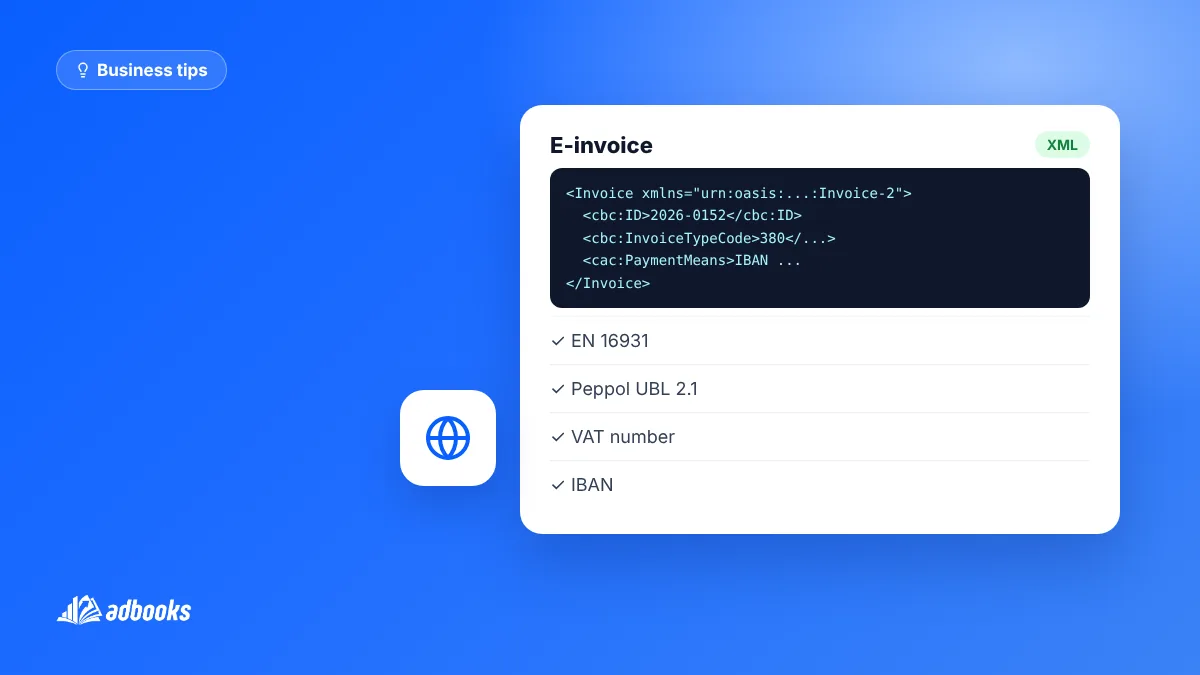
E-invoicing is no longer only for large corporations. Across Europe, countries are making structured electronic invoices mandatory between businesses - and a PDF sent by e-mail is not an e-invoice. Here is what e-invoicing means, which deadlines apply in the most important countries and how small businesses can prepare without stress.
In short
- An e-invoice is a structured file (usually XML) that the client's software can read automatically - a PDF is not enough.
- The European standard is EN 16931; Peppol UBL 2.1 is one of the most widely used formats.
- Germany, Belgium, France, Poland and Croatia are introducing mandatory B2B e-invoicing in stages.
- The EU plans e-invoicing for cross-border B2B transactions from 2030 (ViDA).
What is an e-invoice?
An e-invoice is an invoice in a structured, machine-readable format. Instead of a picture of an invoice (PDF or paper), the client receives a file in which every piece of data - seller, buyer, VAT number, items, amounts, IBAN - is in a defined field. The client's accounting software imports it automatically, without retyping.
EN 16931 and Peppol UBL 2.1
EN 16931 is the European standard that defines which data an e-invoice contains. Peppol UBL 2.1 is a widely used XML format based on that standard, and Peppol is also a network through which businesses and public authorities exchange e-invoices. Many national formats are built on the same standard.
Deadlines in important countries
The dates below are the plans known at the time of writing. Governments change them from time to time, so check with your tax authority or accountant.
Germany
Since 1 January 2025, all businesses must be able to receive e-invoices from other businesses. Issuing becomes mandatory in stages: from 2027 for companies with a prior-year turnover above 800,000 €, and from 2028 for all businesses. Accepted formats include XRechnung and ZUGFeRD, both based on EN 16931.
Belgium
Since 1 January 2026, e-invoicing via Peppol is mandatory for most B2B transactions between Belgian VAT-registered businesses.
France
France introduces mandatory e-invoicing in stages from September 2026: all businesses must be able to receive e-invoices, large and mid-size companies must issue them first, and small and micro businesses follow from September 2027.
Poland
Poland introduces the national system KSeF, through which invoices between businesses must be issued, in stages during 2026.
Croatia
From 2026, Croatia requires e-invoices between VAT-registered businesses as part of its new fiscalisation rules.
The EU: ViDA
With the "VAT in the Digital Age" (ViDA) package, the EU plans to make e-invoicing mandatory for cross-border B2B transactions within the EU from July 2030, and to let member states introduce domestic e-invoicing more easily.
Why e-invoicing is good news for small businesses
- Faster payment - invoices go directly into the client's system, without delays and retyping.
- Fewer errors - missing VAT numbers or wrong IBANs are found before sending.
- Less paperwork - no printing, scanning or sorting.
- Ready for the future - when your country makes it mandatory, you are already prepared.
How to prepare in five steps
- Check your clients: which of them already request e-invoices, especially public authorities and large companies?
- Check your master data: correct VAT numbers, addresses and IBAN for you and your clients.
- Choose software that exports EN 16931 / Peppol UBL, not only PDF.
- Ask your accountant which national rules and deadlines apply to you.
- Test early: send a few e-invoices before it becomes mandatory.
E-invoices included in every plan: AdBooks creates a Peppol UBL 2.1 (EN 16931) XML next to every PDF and checks IBAN, VAT number and items before export. Try it free for 14 days.
Please note: some countries additionally require national systems or certified platforms (for example fiscalisation or KSeF). AdBooks does not connect to national fiscalisation systems, so check with your accountant what applies in your country.
Frequently asked questions
Is a PDF invoice an e-invoice?
No. A PDF is an electronic document, but not a structured e-invoice. An e-invoice is a machine-readable file, usually XML, according to EN 16931.
What is the difference between Peppol and XRechnung?
Both are based on EN 16931. Peppol UBL is used across Europe and is also a network for exchanging invoices; XRechnung is the German national format, mainly used for public authorities.
Do I need e-invoices for private clients?
In most countries, the new obligations apply to invoices between businesses (B2B) and to public authorities. For private clients, a normal invoice is usually still fine.
What does e-invoicing cost?
In many invoicing programs it is included. In AdBooks, the XML export is part of every plan.
Conclusion
E-invoicing is coming to all of Europe - the only question is when it becomes mandatory in your country. Businesses that switch early save time, get paid faster and avoid a last-minute rush. Check your data, choose software that exports EN 16931 and start sending e-invoices before you have to.